Sesame: Proving Market Demand Before Building the Infrastructure
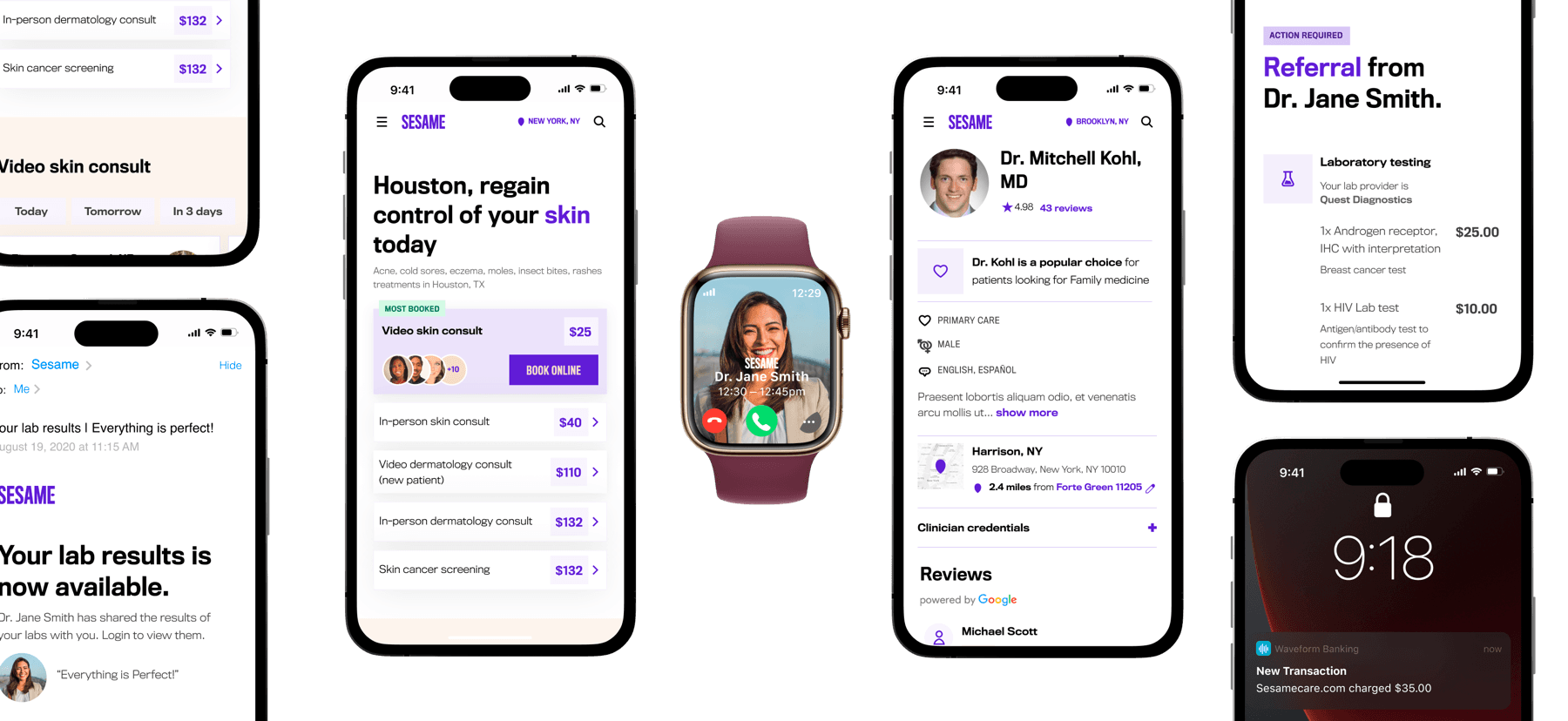
Sesame was a direct-to-consumer healthcare marketplace making affordable care accessible across the US. I joined as Senior Product Designer in Berlin, working across two teams: growth (conversion and metric uplift) and commercial (provider onboarding and supply). Symptom-based search lifted search success 27%, a shorter funnel with pre-fill lifted checkout conversion 3% (4.2% on mobile), quarterly revenue rose 22%, and a scrappy demand-validation play borrowed from GrubHub's early playbook expanded US coverage 18%. The work was part of what closed the Google Ventures round during my time there.
Why Sesame
I left Taxfix for Sesame. Both were in Berlin. I joined for the team more than anything: the calibre of people across product, design and engineering was exceptional. I reported to Natalia Volgina, Head of Design, who reported to CPO Gerard Murphy. Sesame was remote-first, with product, design and engineering in Berlin and the commercial team in New York.
I started on the growth team: conversion and market expansion. Sesame was concentrated in the Northeast US and needed to prove it could scale. Later I also picked up work on the commercial team, on the provider side, onboarding more practitioners to increase supply. This was peak Covid, and telehealth demand was enormous.
The growth team was a single squad: two front-end engineers, one back-end engineer, one PM and me, with occasional support from other teams. Leadership set strategy through OKRs. The CPO presented the vision and objectives to the product org, each squad broke it down into the targets we believed were right, and we presented our plans back and got challenged in sparring sessions before committing. My role was execution, not strategy, and the process meant I understood the strategic context for everything I built.
I joined for the team more than anything else. The calibre of people, the working relationship between product, design and engineering, the respect for quality. It was my favourite job.
The Growth Problem
Sesame had product-market fit and needed to prove it could improve core metrics and expand geographically. The company was in a bridge round and Google Ventures was interested, on the condition of demonstrable metric uplift: signup conversion, retention, time to value. They also wanted to see that Sesame could grow beyond the Northeast.
The user journey had too many steps. A patient landed with one of two mindsets: "I know what I need" (a specialty or practitioner type) or "I'm feeling this and I don't know who can help". We designed two routes: a specialty path for patients who had already researched, and a symptom path that translated what patients felt into practitioner recommendations.
Across both we applied Hick's law systematically. When users face too many options, decision time rises and drop-off follows. We did not hide options; we distributed them across detail pages so each decision point had fewer choices. We reduced the end-to-end flow from roughly seven steps (land, search, match, select, find a time, checkout, confirm) to a tighter sequence, and later added pre-fill for returning users: if you had checked out before with the same details, we populated them with a consent checkbox, the way a medical office keeps your details on file.
How We Measured Everything
We ran experiments constantly, fewer than ten in my time, each one chosen jointly by the PM and me, and measured them against the metrics GV cared about. The stack was Mixpanel for product analytics, Hotjar for session recordings and heatmaps, UserZoom for moderated testing, SEMrush for SEO.
The accelerator was the design-to-experiment pipeline we built with engineering. Design components were built as React Storybook components, then connected to Contentful so that content, card conditions, tags, button labels and routing were all CMS-controlled. Anyone in product, marketing or operations could change the site and launch an experiment with no front-end work.
This changed how we designed. For any problem we would explore three approaches, build two, and deliberately reuse components between them. When it came time to test, swapping variants was a CMS change, not an engineering ticket. It cut our time to market significantly; we were shipping and measuring at a pace a traditional design-to-dev handoff could not have matched.
- Search success up 27% with symptom-based search
- Checkout conversion up 3%, and 4.2% on mobile, with the shorter funnel and pre-fill
- Quarterly revenue up 22%
- US market coverage up 18% through the expansion play below
- The symptom-based search MVP shipped in 2.5 weeks
For any problem we would explore three approaches, build two, and reuse components between them. Swapping A/B variants was a CMS change, not an engineering ticket.
The Provider Side
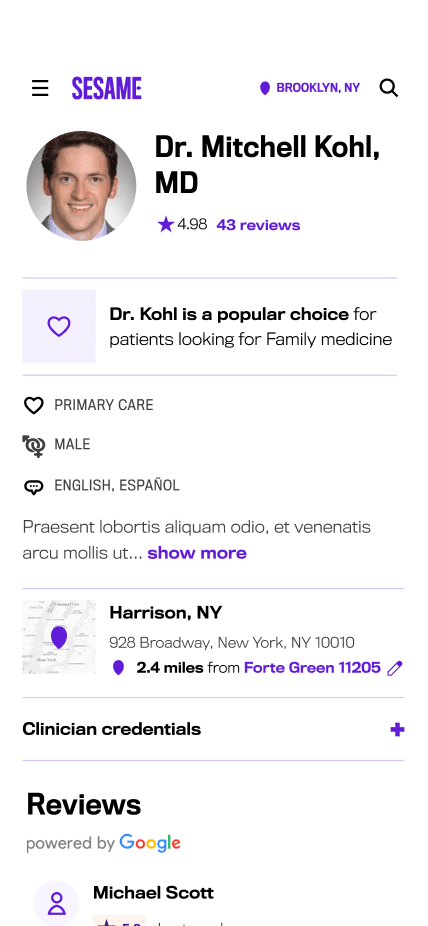
On the commercial team I ran discovery with healthcare providers to understand what limited their willingness to join the platform and refer more patients. The pattern was clear across GPs, nurse practitioners and specialists: most appointments ended with a lab or imaging order, bloods, X-rays, MRI, CT. That was a gap in our product and a gap in the market.
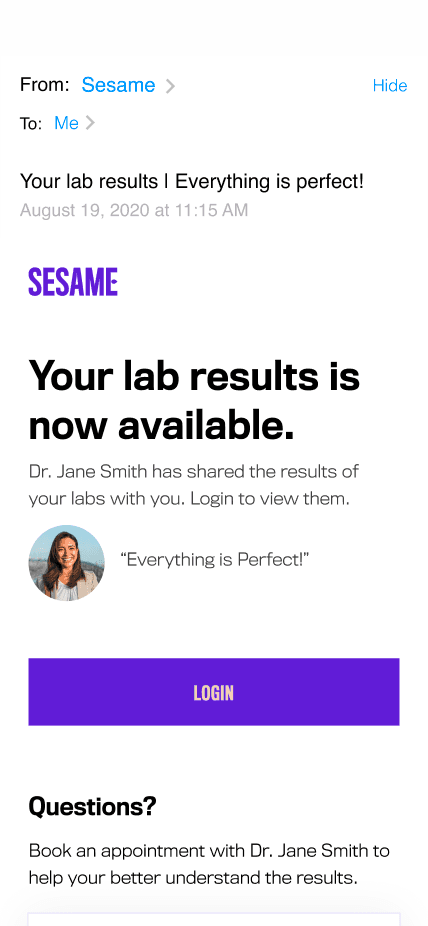
Sesame is a cash-payment platform that bypasses insurance entirely. That is the core value for patients: transparent pricing without insurance complexity. We designed a feature that let practitioners order labs through Sesame during a telehealth appointment. The order went to the patient as a cash-pay transaction, keeping the whole workflow inside Sesame. Practitioners had a reason to bring more of their workflow onto the platform, and patients could get labs ordered and paid for without touching their insurance.
Most appointments ended with a lab order. We built it into the telehealth flow so the whole transaction stayed inside Sesame's cash-pay ecosystem.
The GrubHub Play
To prove geographic expansion we borrowed from GrubHub's early strategy. GrubHub listed restaurants before those restaurants had signed up; you could order, and GrubHub would call the restaurant on your behalf. We did the same with healthcare practitioners.
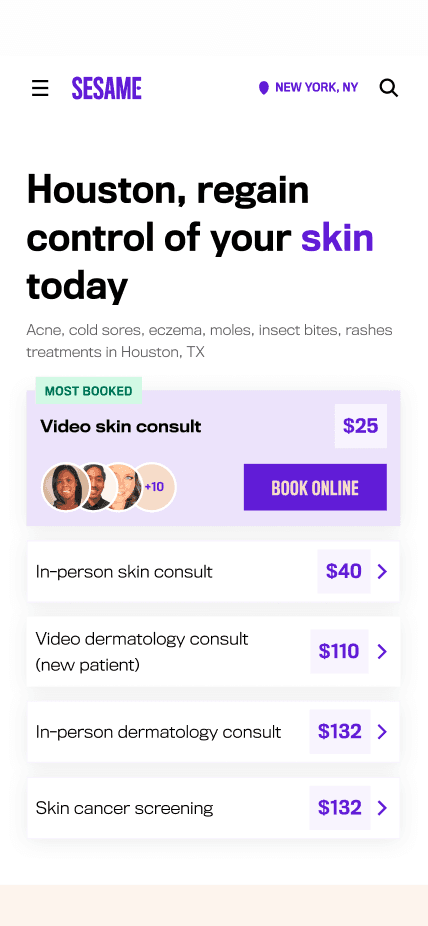
We targeted Southern and Western states, Houston among them. We scraped practitioners in the specialties we supported, listed them on the Sesame site, and let patients book. When someone booked, our operations team called the practitioner, made the appointment for the time the patient had chosen, and acted as the middleman.
We listed practitioners before they had signed up. When a patient booked, our ops team called the practitioner and made the appointment on their behalf. GrubHub for healthcare.
That let us measure real demand in new markets without investing in operations, integrations or commercial relationships up front. We could see how many patients in Houston wanted to book a dermatologist before we had spent a dollar on the supply side.
What Went Wrong
The unlisted-provider model hit a wall. The back-and-forth between patient and practitioner took too long when an ops team mediated it. Patients would book, and by the time we had confirmed with the practitioner, many had cancelled. The demand was real; the fulfilment could not keep pace.
Telehealth had its own problems. During peak Covid, teleappointments were central to Sesame's offering, and there were no charges for rescheduling, so practitioners could not onboard new patients because existing ones kept moving their appointments. It became a bottleneck on revenue growth.
The demand was real. The fulfilment could not keep pace. Patients cancelled because the back-and-forth with unlisted practitioners took too long.
Why It Worked Anyway
Internally the expansion experiment was counted a success despite the cancellations. We had validated demand before investing in any infrastructure, without committing to operations, technology or commercial relationships, and we had real data on which markets wanted which specialties.
That data became a sales tool. When we approached unlisted practitioners to onboard them formally, we showed up with traffic, booking attempts and analytics from their listing. The conversation moved from "would you like to join our platform?" to "here is the demand that already exists for you". Provider acquisition got dramatically easier.
The metric uplift from the experiments on the core product and the expansion proof were part of what closed the Google Ventures round during my time there. It was a team effort across product, design, engineering and operations, and the work on growth and expansion was central to it.
We showed up to practitioners with traffic data and booking attempts from their listing. The conversation shifted from "would you like to join?" to "here is the demand that already exists for you".
Trade-offs
What I chose, what it gave up, and what I would revisit.
- Chose to list practitioners before they had signed. Gave up fulfilment we controlled, and patients cancelled when confirmation took too long. Would revisit the confirmation loop: minutes not hours, or a cap on bookings per unsigned provider.
- Chose a CMS-driven component pipeline over bespoke builds per test. Gave up freedom in each variant. Would revisit: no. Swapping a variant became a configuration change.
- Chose two routes in, specialty and symptom, over one simpler path. Gave up a single funnel to optimise. Would revisit: no; the two mindsets were real.
- Chose to leave rescheduling free during peak telehealth. Gave up revenue growth on the provider side while existing patients kept moving appointments. Would revisit: yes; the incentive problem was never solved while I was there.
What Carries Forward
The measurement discipline at Sesame shaped everything after it. Experiments run against real metrics, a component pipeline that made experimentation cheap, and demand validated before infrastructure was built: these became foundational to how I think about product work.
It is also where I met Bishesh. He was the lead front-end developer on the growth team, and his ability to implement a design to exact spec was unlike anything I had seen. That working relationship led directly to co-founding Strike Analytics.
What made Sesame different was the culture. Gerard Murphy's leadership set the tone: genuine respect for every person in the room regardless of role or background. The trio between product, design and engineering worked the way it is supposed to. Everyone was exceptionally good at their job and cared about quality. I have been chasing that environment since.
The best professional partnerships come from shared standards, not shared ambitions. Bishesh and I co-founded Strike because we had already proven we could build together.
---