Strike Analytics: 13 Pivots, Four to Ten Paying Customers, and the Method That Survived
Four founders raised $125K from friends, family and personal savings to build an AI analytics platform. Over 14 months we interviewed 50+ people across 20+ cities, built ML pipelines, pivoted 13 times, and ended with between four and ten paying customers. We ran out of money. This is an honest account of what went wrong, what we built, and what I carried forward into everything I have done since.
The Real Problem
The observation was genuine. Companies were drowning in data but starving for insights. Qualitative research lived in Notion, marketing performance in Google Analytics, support conversations in Intercom, sales data in HubSpot. Nobody could see the connections between them, and by the time teams manually correlated different data types, market conditions had already changed.
We interviewed over 50 people across 20+ cities: product managers, engineering leads, C-level executives, eCommerce operators, agency founders. The gap between what customers said they needed and what they did with data was enormous. Most analytics tools could tell you the what and missed the why behind user behaviour.
We validated the problem thoroughly. Where we failed was everything that came after.
Four Founders, $125K
We went with four founders deliberately. Bishesh, my CTO, who I had worked with at Sesame, was in Berlin. Georgia came from a product management background with 0-to-1 experience. Tara had a customer success and operations background with a linguistics specialisation; she developed the ontological model that underpinned our AI's language processing. I owned design, product strategy and eventually most of the go-to-market.
The logic was that four founders could cover more ground than two. Between us we had design, engineering, product, operations and linguistics. We thought cross-functional coverage would compensate for having no money. It did not.
We raised $125K AUD from friends, family and personal savings. Our one direct hire was a data scientist who handled model training and automation. Beyond the five of us, six others stayed because they believed in what we were building: user researchers, a backend engineer, consultants and advisors. Most worked without pay.
When you are spending your own money and your friends' money, you develop a different relationship with every dollar. That hyper-fixation on cost shaped everything I have built since.
What We Built
Working with our data scientist, I architected an ML system that combined several approaches. The key was using models together rather than in isolation, each algorithm validating and enriching the others' findings.
- Topic modelling to find patterns in customer conversations and support tickets
- ARIMA models for time-series forecasting of engagement and retention
- Logistic regression to predict conversion likelihood from multi-variable inputs
- Sentiment analysis to quantify emotional responses in qualitative feedback
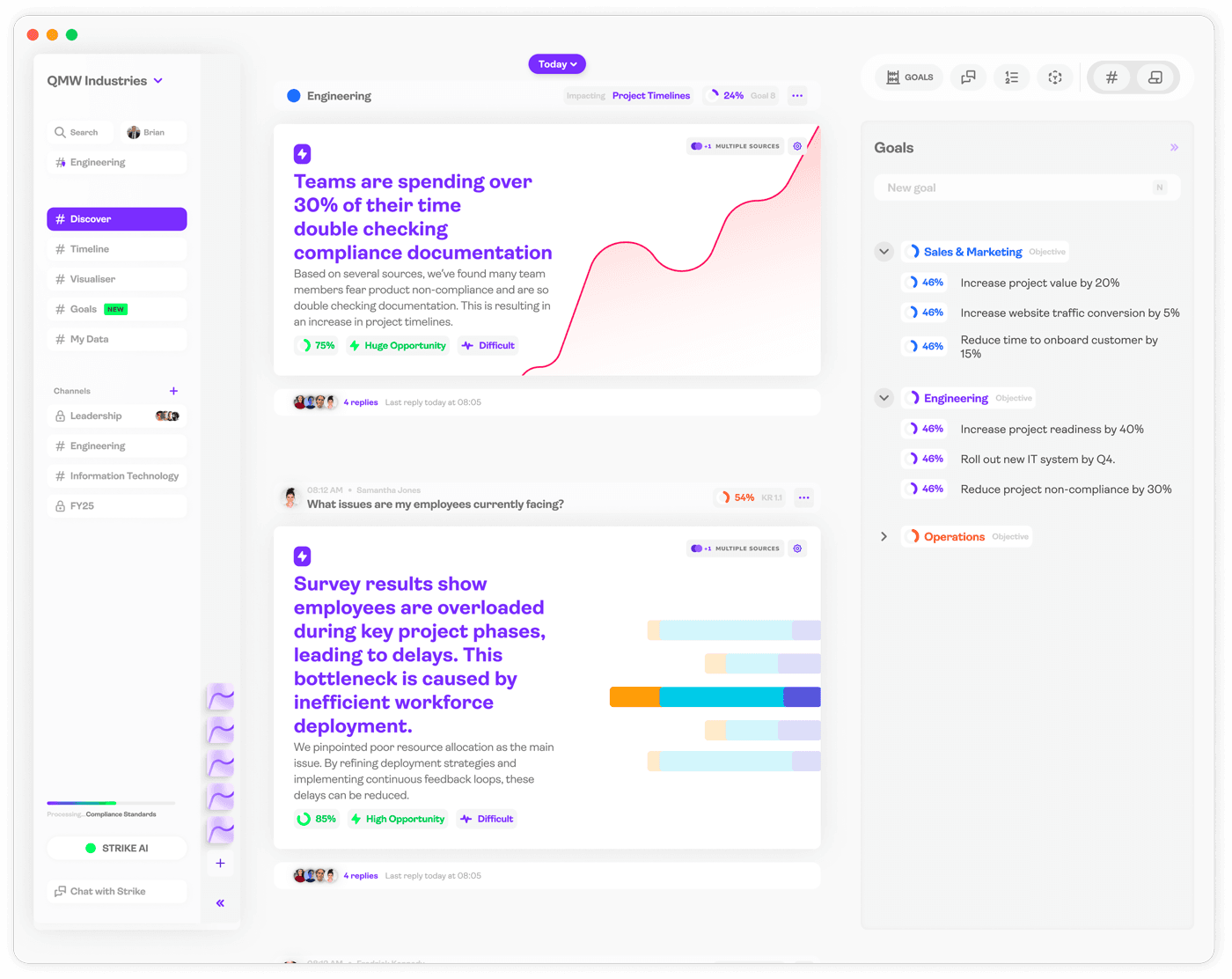
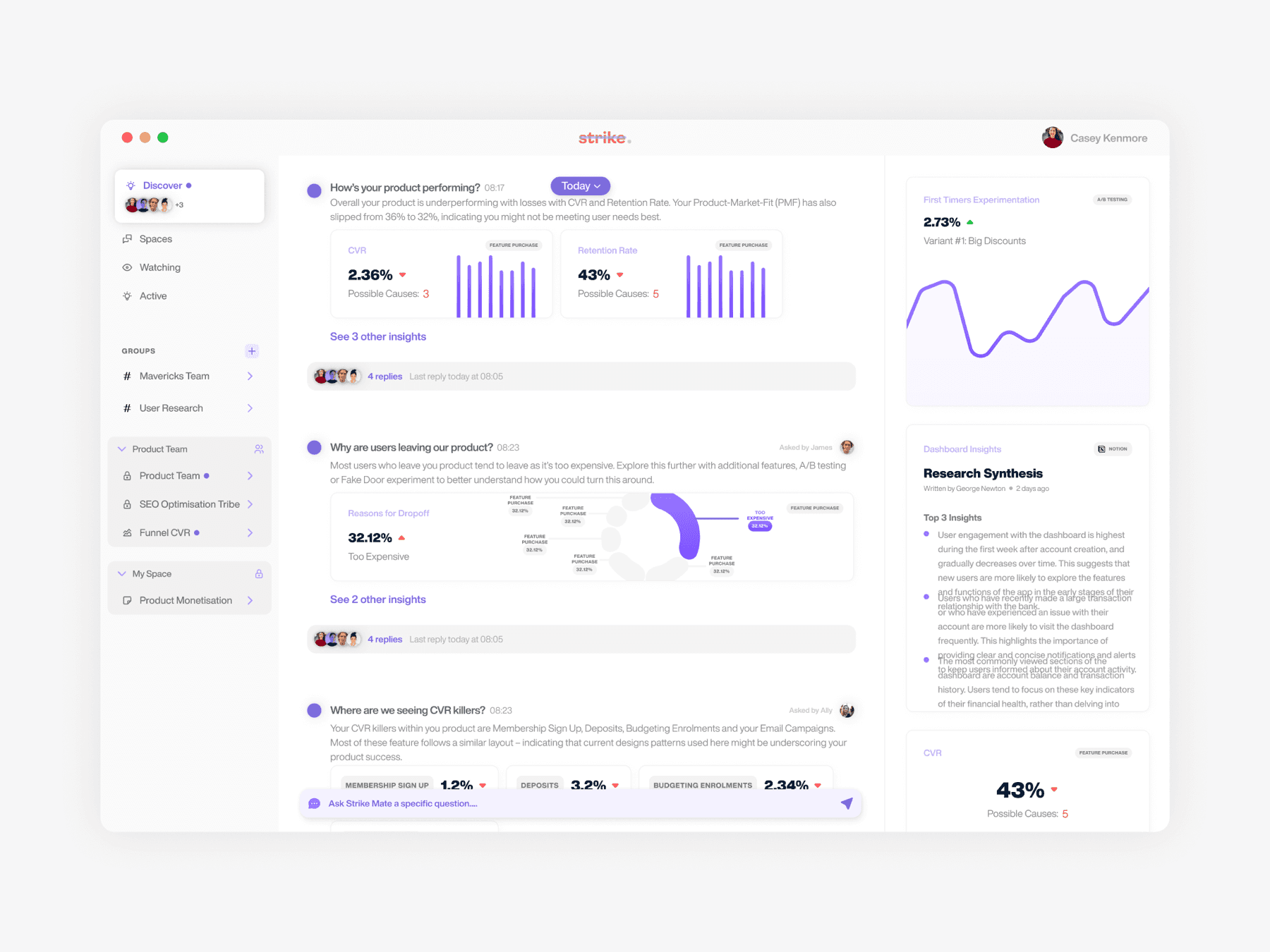
Every algorithmic decision had to be explainable. We could not just tell users what to do; we had to show why the AI reached those conclusions. I designed a progressive disclosure interface that surfaced the key insights immediately and let users drill into the reasoning behind each recommendation.
In our pilot programme we surveyed and observed how teams generated insights. Roughly two hours reviewing existing data sets, two hours reviewing customer insights, time scheduling and running interviews, then two hours of synthesis, repeated across participants: well over fifteen hours for a single round of qualitative insight. Our platform compressed that significantly, and the honest truth is we never had enough paying users to validate the compression at scale.
13 Pivots
We instrumented everything to understand how teams used our insights. The data told us something we did not want to hear: people would look at our analysis, say "that's interesting", then do nothing. The gap between insight and action was where every analytics tool failed, including ours.
People would look at our analysis, say "that's interesting", then do nothing. That gap killed us.
What followed was 13 pivots over 14 months. We pivoted fast, sometimes weekly, driven by customer research and an AI landscape changing underneath us at the same time. One week's technical assumptions were obsolete by the next. Each pivot tried to be bolder than the last.
Each one started as a written hypothesis and died on a metric threshold or a research finding. Linear held the work and I owned the priority; Notion held the reasoning. I ran weekly planning and review with a daily async standup across four countries.
- Users stalled on blank chat screens with no idea what to ask. Pivoted to pre-defined insight stories aligned to each user's role
- Leaders did not want to use a product themselves; they wanted insights brought to them. Shifted focus to the product managers and designers who work with data
- Marketing data surfaced the most actionable insights. Expanded from product teams to cross-functional marketing teams
- Customers without product functions relied on full-service agencies, and agencies were terrified AI would replace them. Pivoted to serve agencies directly
- Agencies used 10+ tools and resisted consolidation. Narrowed to eCommerce businesses with small teams managing their own data
- Compared eCommerce operators with digital product expertise against those without: the skill gap in conversion was enormous, and the people who needed help most could not articulate what help they needed
- Pivoted from analytics to automation: real-time, per-session website optimisation using a component library connected to customer mindsets and psychology, running continuous A/B tests that learn and refine automatically
The final direction was compelling. We had a working miniaturised prototype. US investors were interested; some turned us away only because they had already invested in the space, which told us we were in the right territory. The technical challenge was training the model to identify which component changes to make for a given mindset. Changing the components was not hard. Training the psychology layer was.
By the time we found the vision that excited investors, we had no money left to build it.
What Went Wrong
Several specific mistakes were detrimental. The biggest was hiring. We brought on too many non-technical, go-to-market people before the product was mature enough to sell. People were focused on outreach when there was not enough behind what they were pitching. With $125K, we should never have hired that many people on that tight a runway.
I hired a friend. I should not have. I should have gone to market and found the right person for a specific role on a contract with a fixed scope and timeline. I have a clear framework for this now: contractors first, measure the impact, convert to permanent only when the workload cannot be handled through process or tooling.
We also got contradictory advice. Australian VCs told us to sell more. US VCs told us to build more into the product. With no prior sales experience on the founding team, we could not do either well. We believed we had a strong product and could not find the vector into the right conversations with the right people. Maybe we were in the wrong location. Maybe we did not raise enough up front. Maybe we did not talk to enough customers early enough, or validate with prototypes before building.
We pitched 24 VCs from 1,289 targeted outreach emails and completed four accelerator programmes. Our LinkedIn campaigns achieved an 8.55% click-through rate, six times the industry benchmark, and a 1.86% beta sign-up conversion. We had 40+ beta sign-ups across eCommerce, agencies and SaaS, and between four and ten of them paid. Interest was never the problem. Conversion to revenue at any scale was.
The End
We ran out of money. We stretched $125K from a projected six months to fourteen. All four founders and our data scientist stayed until the end, earning no income for several months, trying to find the outcome we were looking for. Eventually we had a conversation and closed down.
Five people stayed for months with no income because they believed in the problem. That commitment deserved a better outcome than the one I delivered.
There is nothing dramatic about how it ended. No blow-up, no conflict. We could not sustain it any longer. The technology we built, the data we collected, the ontological model Tara developed: the real value of a tech startup lives in its data, not its product, and we did not have enough of either.
Trade-offs
What I chose, what it gave up, and what I would revisit.
- Chose four founders for coverage. Gave up focus and equity, and ended with no one whose job was selling. Would revisit: sales on the founding team, non-negotiable.
- Chose to hire go-to-market people early, one of them a friend. Gave up runway on outreach with too little product behind it. Would revisit: contractors on fixed scope first, permanent only when process and tooling cannot carry the load.
- Chose to pivot fast, sometimes weekly. Gave up depth on any one direction. Would revisit the kill criteria being written before the build, not after; the hypothesis-per-pivot discipline came from this.
- Chose explainable recommendations over a black box. Gave up speed to a first result. Would revisit: no. "That's interesting" followed by nothing was the failure, and explainability was the only lever on it.
What Carries Forward
I would not be where I am without Strike. When you are spending your own money you develop a different relationship with waste. Every assumption that goes unvalidated is money burning. Every week spent building without testing is a week you cannot afford. That pressure produced a methodology I apply everywhere now.
At Emesent I do things differently because of Strike. I take several concepts to customers in rapid cycles rather than testing one thing at a time. I use prototypes as instruments to collect data, not to validate a solution. Sometimes the prototype reveals something the customer never anticipated, and that is where the real direction comes from. At Strike I would have spent weeks building before testing. At Emesent I spend hours.
The prototype is not the deliverable. The data it collects is the deliverable. That distinction came from Strike.
- Validate with prototypes before building; it is the cheapest way to be wrong
- Hire contractors with fixed scope before committing to permanent roles
- The gap between insight and action is where most products fail; design for the action, not the insight
- Sales experience on the founding team is non-negotiable
- When VCs give contradictory advice, you have not validated enough to know which one is right
- Speed of iteration compounds; five fast cycles beat one thorough one
---